The digital revolution has come a long way, to the point that the digital world has seamlessly intertwined into our physical world in so many ways. Many long standing organisations have adapted to this new world offering us services that take advantage of the digital realm. But how about an organisation that started life in the digital world? This blog looks at how Amazon, having already seized the opportunity of the online world, are increasingly impacting the physical world in various ways.
It might be unimaginable to some, yet the vast majority of retail sales continue to occur in physical spaces (Treadgold and Reynolds [2]). As an aspiring Data Science I had to look for myself, using data from the Office for National Statistics the following graph was created based on UK retail sales:
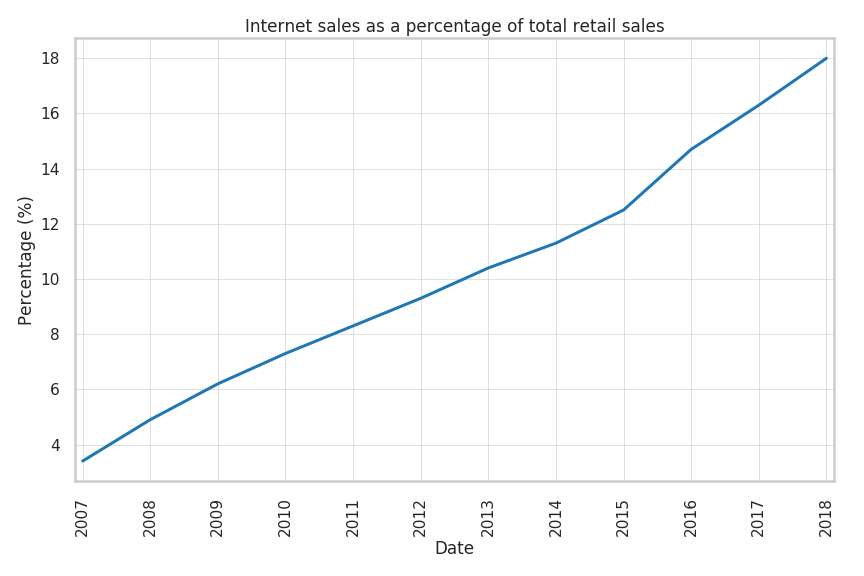
Despite the continued online growth we can see more than 80% of retail sales still occur in the physical world, clearly showing motivation for a physical presence. So how are Amazon taking advantage of operating in both worlds? Lets look at some examples.
Amazon Go
Powered by Machine Vision and Machine Learning techniques, the idea is potentially transformative in the way we buy our groceries, while also giving us an idea of how shops will look in smart cities. The store works with an Amazon Go phone application, scan in on entrance then take what you want and just leave. Amazon bills your account as you pass through the turnstile on the way out. This example perfectly illustrates how Amazon are seizing the opportunities of converging the physical and digital spaces. Take a look at Amazon’s introductory video for this technology, the future of retail certainly is exciting.
A promising idea however does not come without its challenges, the cutting edge technologies used have had its teething problems, issues occur when too many people are in the store or even naughty children messing with the algorithms! Being one of the pioneers in this technology mean that problems are not easily overcome, since there is no precedence as to how to proceed.
Another potential challenge is potential damage to their reputation, Amazon hold the trademark for the slogan “No Queue. No Checkout. (No, Seriously.)”, this could come back to bite them if they are not able to handle demand in their stores with many reports on Twitter of customers having to queue just to get in the store, this is clearly one main issue Amazon will have to resolve if they want their stores to take off in a big way.
Book stores

Watabe and Iwasaki [1] highlight various factors that effect a customer’s decision making process, with “brand” being highly determinant for a consumer deciding to make a purchase. A study by the Harvard Business Review found that the more channels a customer has access to the more valuable they are spending over 10% more than customers who only have access to a single channel.
So why bring this up? Well the book stores so far are not making profit, with speculation that Amazon do not intend these stores to make money directly. Rather adding another channel for customers to interact with, will add loyalty and trust in the brand, indirectly adding more sales long term.
The stores themselves allow customers to feel and touch books, to learn the price a customer must take the book to a scan kiosk, where they’ll see the RRP and the Amazon Prime price. If the customer is a prime customer they are able to purchase the book physically at the lower price. In some ways these stores can be seen as encouraging more prime subscribers, since to fully enjoy the benefits of the store requires a prime subscription.
The main challenge, and something Amazon is used to, is the backlash from traditional bookshops. This interesting article looks at how many independent book stores in Chicago joint together to issue a statement warning of the negative impacts of Amazon on local communities.
Amazon cloud services – powering future smart cities?
We have seen how Amazon are attempting to merge digital and physical retail experiences into a seamless experience, changing from the retail theme we can see Amazon effecting the physical world in different ways.
They have ambitious plans that their services will underpin many smart city applications operating in the physical world.

While Amazon cloud services are an online service (it’s not really a cloud, it’s a computer!), Amazon are clearly taking advantage of opportunities in the physical world indirectly.
It doesn’t take long to find smart city applications built on the platform such as Miovision, that monitors traffic and help ease congestion problems with the help of AI. The technology was deployed to the town of Milton, Ont and quickly identified irregular light timings were causing problems, with a simple adjustment the town saw significant improvements in traffic.
Closing thoughts
It seems Amazon are determined to invade many areas of the physical world already showing signs of using disruptive technologies that provide us with more convenient shopping experiences, potentially becoming one of the pioneers as to how all shops will look in the future, all perhaps interconnecting and communicating in a smart city.
However, Amazon providing computing power for smart city applications poses risks. What if Amazon’s services do underpin the backbone of most of a smart city’s technology? There could be an issue with a centralized point of failure potentially causing mass disruption. In 2017 a typo took down S3, an Amazon cloud service powering the backbone of the internet temporarily causing many large websites to go offline. Now imagine something similar happening if Amazon’s cloud services are powering the backbone of most smart technologies in a city. Developers then perhaps have a responsibility to ensure their applications are decentralized, after all Amazon are not forcing anyone to develop on their services.
References
[1] K. Watabe and K. Iwasaki, “Factors Affecting Consumer Decisions about Purchases at Online Shops and Stores,” The 9th IEEE International Conference on E-Commerce Technology and The 4th IEEE International Conference on Enterprise Computing, E-Commerce and E-Services (CEC-EEE 2007), Tokyo, 2007, pp. 80-90.
[2] A. Treadgold and J. Reynolds. (2016-06-30). Reimagining the Retail Store. In (Ed.), Navigating the New Retail Landscape: A Guide for Business Leaders. : Oxford University Press,.
[3] AWS for Smart, Connected and Sustainable Cities. Accessed: 8th February 2019. Available at: https://aws.amazon.com/smart-cities/
[4] S. Dey, A. Chakraborty, S. Naskar and P. Misra, “Smart city surveillance: Leveraging benefits of cloud data stores,” 37th Annual IEEE Conference on Local Computer Networks – Workshops, Clearwater, FL, 2012, pp. 868-876.
doi: 10.1109/LCNW.2012.6424076
[5] E. Sopadjieva, U. M. Dholakia and B. Benjamin, “A Study of 46,000 Shoppers Shows That Omnichannel Retailing Works”. Harvard Business Review. Available at: https://hbr.org/2017/01/a-study-of-46000-shoppers-shows-that-omnichannel-retailing-works
 Tom's Data Science Journey
Hi Tom! A very interesting article there about the transition of Amazon from the digital to the physical. I do agree with your views and I would like to pick up on one of the points that you made in your insightful post
First, the case of Amazon seems to be quite unique, as it is moving from the digital to the physical space and not the other way around. A lot of traditional high street retailers like M&S and Debenhams are trying to increase the share of their online sales. as a result of a decrease in the footfall in their brick and mortar stores.Others like John Lewis as well as moving online, are trying to adapt to the changing consumer habit by trying to make shopping in traditional ”offline” stores more like an entertaining experience to try and bring more people in.
Whatever, the future of high street retailers, the way we do our shopping is changing and if and how stores will adapt remains to be seen.
LikeLike
Thankyou for your comment Damyan. I agree that the way we do our shopping is changing and it’s unpredictable how things will turn out. One thing that seems certain is those that are slow to adapt could be in trouble as we’ve already seen with the likes of Blockbusters, Woolworth’s and probably many others.
LikeLiked by 1 person
Hi Tom, great article and even though I wrote about Amazon myself, you still approached it in a completely different way.
With regards to the queuing issues that you mentioned at the current Amazon Go stores, I believe this may also just be a teething issue with consumers wishing to try out this new idea and even if demand continues to remain at such a high level, I think Amazon can only create more opportunities from this. Admittedly, this is not a quick fix but, as reported by Bloomberg (https://www.bloomberg.com/news/articles/2018-09-19/amazon-is-said-to-plan-up-to-3-000-cashierless-stores-by-2021), Amazon is considering the expansion of their Go shops, which could increase from the current 10 locations to up to 3000 by 2021, that would hopefully relieve some of the traffic in the current locations! Do you think an increased number of locations would reduce these queues or do Amazon need to look for a different solution to reduce wait times?
LikeLike
Hello Felix, thank you for your comment.
I read your article, always interesting to hear / read different insights to similar topics. I’m sure Amazon are working hard to resolve the queuing issue and I would think increasing store numbers will help. However while the demand is one of the issues I also read it’s a technical issue too. Since the Machine Vision / Machine Learning algorithms find it difficult to deal with more than a certain amount of people at any one time they have to implement a kind of ‘one out, one in’ system at the turnstile. I can appreciate how much of a technical challenge this is for them to accurately predict multiple customers shopping baskets, and I’m sure they are making progress in this regard.
LikeLiked by 1 person
Hi Tom
Thank you for such an interesting read on Amazon – I had no idea they were involved in smart city activity! With such power and infrastructure in place, it seems they could make a real difference to everyday life. Do you know of any other commercial organisations that have similar smart city ambitions?
Emily
LikeLike
Hello Emily,
Smart City industry is expected to be a $400 billion market by 2020 according to a report by McKinsey research. They created an interesting report that covers a lot of different effects and impacts on people: https://www.mckinsey.com/~/media/mckinsey/industries/capital%20projects%20and%20infrastructure/our%20insights/smart%20cities%20digital%20solutions%20for%20a%20more%20livable%20future/mgi-smart-cities-full-report.ashx
Considering the potential profit, if you research any large tech company you’ll likely find many have grand ambitions and exciting potential innovations for smart cities, the two that came to mind are:
IBM : https://www.ibm.com/smarterplanet/us/en/smarter_cities/overview/
Intel : https://www.intel.co.uk/content/www/uk/en/internet-of-things/smart-cities.html
Thankyou for your comment 🙂
LikeLike