I love nothing more then an interesting coding or Data Science challenge, a cup of coffee and some alone time on a computer while I figure it out. However this term I decided to leave my comfort zone and pick Digital Business Models for one of my modules. A module that encourages writing publicly, interacting with others and sharing ideas, and I’ve been pleasantly surprised how much this approach enriched my learning experience.
Reflecting
Reflection can deepen understanding, transform perspectives and assist growing from experiences [1]. So lets look back and reflect on the value I’ve gained from reading and commenting on work of other blog authors.
The topics on this module covered a range of subjects that I’m interested in such as artificial intelligence, the digital world and smart cities, importantly we looked at how these topics are affecting digital businesses. Amazon is a great company to study that brings many of these aspects together and the subject for one of my blogs.
One of the first things thing that surprised me is learning from someone who has approached the same subject as you with ideas you had never thought of. I commented on Felix’s blog on Amazon’s transition to operating in a physical world, specifically Felix raised an important point that transitioning to a physical world is much easier when a company already has a strong infrastructure and a solid distribution network, something I hadn’t even thought about and showed my naivety towards a fundamental aspect of retail business.
I enjoyed reading Damyan’s blog, in particular this post on Booking.com’s digital business model, I was interested to hear Damyan’s thoughts on the potential decentralization of the travel industry and opened my mind to the fact that travel companies can offer much more then just being an intermediary agent between suppliers and customers and that if these companies are able to adapt they should still be able to thrive if such a scenario was to occur.
Having an interest in gaming I found Siwat’s post on game stores and Simon’s post on Valve insightful. I never knew that Valve started as a game developer for example that ended up building one of the biggest digital game stores. Thanks to these blog posts I gained a greater understanding of companies that I never thought of too deeply before and probably would have never looked into myself.
I’ve learned to read as much variety as possible on many areas, you never know when something will ‘click’ while you’re enjoying a blog or an article.
Moving forward
I created a video as a reminder for my future self of the goals I should be sticking to. In general one big thing I want to take away from this module is to be more open to networking and opportunities to connect with others.
FI also plan to carry on using this blog to talk about Data Science from a beginners prospective to help strengthen my own understanding. Hope to see you in my next blog post. 🙂
[1] Glaze, J.E., 2001. Reflection as a transforming process: student advanced nurse practitioners’ experiences of developing reflective skills as part of an MSc programme. Journal of Advanced Nursing, 34(5), pp.639-647.
Towards the end of 2013 when OnePlus launched there was a smartphone to suit all kinds of budgets, with Apple and Samsung dominating the high end yet expensive market and by compromising on quality, features or specifications there were different offerings to suit a range of budgets. How were OnePlus going to make an impact in such a saturated market? This blog takes a look at OnePlus’s David vs Goliath story that led to them becoming one of the top smartphone manufacturers in the world.
The internet enables the creation of businesses that allow global reach easily, however creating a sustainable and profitable online business model is hard (Teese et al. 2017). OnePlus’s online only business model was clear from the start and distinctive from other smartphone manufacturers while competing with some of the largest corporations in the world is no easy task.
Their main goal was simple, target the tech-savvy market who cared about having top of the line, bleeding edge specs but significantly undercut the market. This naturally led to the brand’s tagline that remains today: “Never Settle”, as in there is no need to settle for a lower quality phone if the price is right.
Just to get a general idea of OnePlus’s business model, how were they able to keep prices low? Firstly, by initially selling direct to the consumer they were able to cut out intermediary retail partners. Secondly, by abandoning traditional expensive advertising or marketing campaigns the company were able to pass most of the savings to the consumer.
So we’ve seen that OnePlus are a hugely successful start up, yet a sensible business model and a specific target market is not enough to make for a successful company in just a few short years. You may be wondering, how did OnePlus go against such big established players and make a name for itself so quickly? Let’s take a look at some of the online strategies OnePlus deployed.
Invite only online system
Entering a saturated market OnePlus knew it had to do things differently and from an early stage the company decided to discard traditional advertising and to sell devices direct to the customer. This led the company to attempt innovative in house strategies that propelled their success.
In 1988 the philosopher René Girard coined the term mimetic desire, the basic idea coming from a school playground whereby children will often all want to play with the same toy. This phenomenon although usually more suppressed is present in adults too and according to Lebreton, Maël et al. (2012) the desires depend not only on the properties of an object but also whether a certain object seems to be a attractive goal to others.
Knowing this, OnePlus’s decision to only make their earlier models available through an online invite only system a brilliant marketing ploy. Initially the system could only be accessed through employees and close associates who in turn invited whomever they wanted to. The initial users of the system helped create an initial group of influencers who were happy to promote the brand for free, engaging with people and convincing them to come on board. This created a sense of excitement and exclusivity, and helped create viral social media waves resulting in people desperate to gain an invite (speaking from experience!), everyone wanted to be part of the “cool” club.
Bearing in mind this was the only way to officially buy a OnePlus phone, as a young start up this had the side benefit of allowing OnePlus to control stock and grow sustainably at their own pace, slowly ramping up production.
Contests
OnePlus always seems to be running an online contest of some kind, another key strategy in creating buzz on social media and connecting new people to the brand, however maybe intentional some are clearly controversial. Take their first contest: ‘Smash the Past’ which encouraged users to share a video online of them smashing their old phones for a chance to buy the OnePlus One for $1.
It certainly brought attention, and I’m not alone in feeling disappointment that OnePlus were promoting such wasteful behavior. The company faced backlash and one month later they were forced to take action allowing people to donate their phones instead. Regardless of the morality and the intentions behind the contest, it was effective, spreading OnePlus’s brand to a wider audience. Reading OnePlus’s response to the backlash gives an insight to the company’s mindset during these early months.
OnePlus is a young startup with bold ideas. It’s tough to just survive in this industry, nevermind shake it up as we hope to do. ‘Smash’ reflects our desire to do just that: show the world that there’s something new available, something that just may be better than your current daily driver. However, we are also strong proponents of using technology to better the daily lives of people across the globe. For this reason, the chosen 100 applicants can choose to either smash their phone as planned, or donate it to the wonderful team at Medic Mobile.
OnePlus to this day still runs regular contests and remain a key part of OnePlus’s online marketing strategy intended to create buzz and viral waves on social media, they certainly play a part in OnePlus’s success.
India presence
Perhaps most pivotal to their success was the decision to target the second most populated nation in the world, not only that a nation full of tech enthusiasts who care about the specific components in their devices. OnePlus saw such promise in India they happily broke their own rules of not partnering up with retail partners, teaming up with Amazon’s Indian shop in December 2014 to offer the OnePlus One exclusively to the Indian public, the only nation that were able to buy the product outside of the invite system described above.
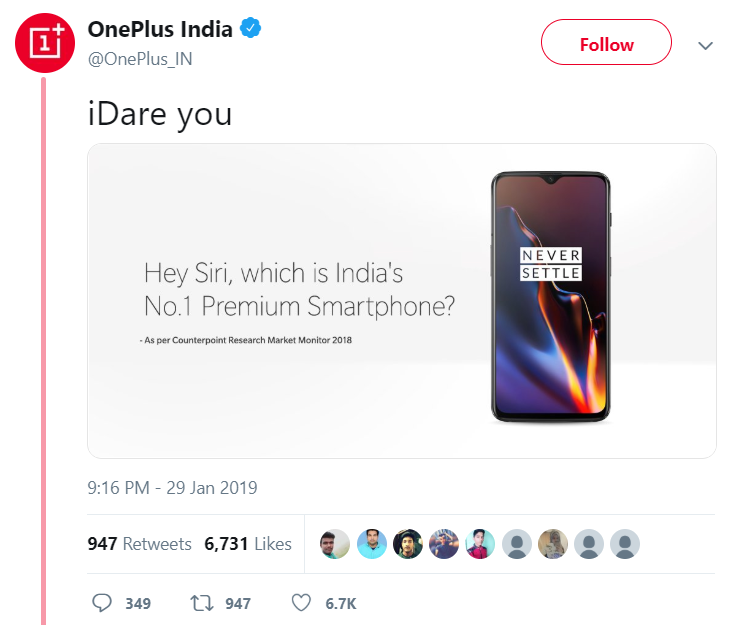
OnePlus also broke another of their rules, carrying out heavy marketing campaigns including sponsoring cricket games and celebrity endorsements (evidence of this can be found on OnePlus’s Indian Youtube channel) across the nation which certainly paid off. It’s difficult finding accurate figures but various reports show that OnePlus are leading the way in the Indian premium smartphone market, some even suggesting OnePlus own 50% share, something that Apple have struggled to achieve. In true OnePlus style, they couldn’t help but tease Apple with the following tweet.
With the OnePlus 7 expected to release mid 2019 the company continues to cement itself as one of the top smartphone manufacturers in the world, in a sense becoming a giant themselves. Technology is difficult to predict and past success does not guarantee growth. Although OnePlus appears to be growing sustainably there is the danger they’ve reached the peak of their hype cycle, they should not become complacent or face the danger of a new start up turning the tables on them!
[3] Lebreton, Maël et al. 2012. “Your goal is mine: unraveling mimetic desires in the human brain.” The Journal of neuroscience : the official journal of the Society for Neuroscience32 21 (2012): 7146-57 .
The digital revolution has come a long way, to the point that the digital world has seamlessly intertwined into our physical world in so many ways. Many long standing organisations have adapted to this new world offering us services that take advantage of the digital realm. But how about an organisation that started life in the digital world? This blog looks at how Amazon, having already seized the opportunity of the online world, are increasingly impacting the physical world in various ways.
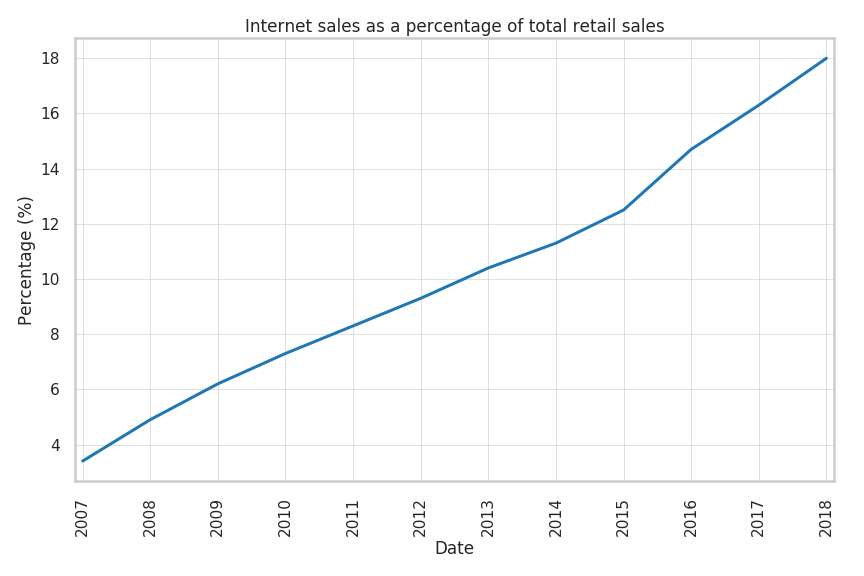
It might be unimaginable to some, yet the vast majority of retail sales continue to occur in physical spaces (Treadgold and Reynolds [2]). As an aspiring Data Science I had to look for myself, using data from the Office for National Statistics the following graph was created based on UK retail sales:
UK internet sales year by year, data source: Office for National Statistics
Despite the continued online growth we can see more than 80% of retail sales still occur in the physical world, clearly showing motivation for a physical presence. So how are Amazon taking advantage of operating in both worlds? Lets look at some examples.
Amazon Go
Powered by Machine Vision and Machine Learning techniques, the idea is potentially transformative in the way we buy our groceries, while also giving us an idea of how shops will look in smart cities. The store works with an Amazon Go phone application, scan in on entrance then take what you want and just leave. Amazon bills your account as you pass through the turnstile on the way out. This example perfectly illustrates how Amazon are seizing the opportunities of converging the physical and digital spaces. Take a look at Amazon’s introductory video for this technology, the future of retail certainly is exciting.
A promising idea however does not come without its challenges, the cutting edge technologies used have had its teething problems, issues occur when too many people are in the store or even naughty children messing with the algorithms! Being one of the pioneers in this technology mean that problems are not easily overcome, since there is no precedence as to how to proceed.
Another potential challenge is potential damage to their reputation, Amazon hold the trademark for the slogan “No Queue. No Checkout. (No, Seriously.)”, this could come back to bite them if they are not able to handle demand in their stores with many reports on Twitter of customers having to queue just to get in the store, this is clearly one main issue Amazon will have to resolve if they want their stores to take off in a big way.
Book stores
Watabe and Iwasaki [1] highlight various factors that effect a customer’s decision making process, with “brand” being highly determinant for a consumer deciding to make a purchase. A study by the Harvard Business Review found that the more channels a customer has access to the more valuable they are spending over 10% more than customers who only have access to a single channel.
So why bring this up? Well the book stores so far are not making profit, with speculation that Amazon do not intend these stores to make money directly. Rather adding another channel for customers to interact with, will add loyalty and trust in the brand, indirectly adding more sales long term.
The stores themselves allow customers to feel and touch books, to learn the price a customer must take the book to a scan kiosk, where they’ll see the RRP and the Amazon Prime price. If the customer is a prime customer they are able to purchase the book physically at the lower price. In some ways these stores can be seen as encouraging more prime subscribers, since to fully enjoy the benefits of the store requires a prime subscription.
The main challenge, and something Amazon is used to, is the backlash from traditional bookshops. This interesting article looks at how many independent book stores in Chicago joint together to issue a statement warning of the negative impacts of Amazon on local communities.
We have seen how Amazon are attempting to merge digital and physical retail experiences into a seamless experience, changing from the retail theme we can see Amazon effecting the physical world in different ways. They have ambitious plans that their services will underpin many smart city applications operating in the physical world.
While Amazon cloud services are an online service (it’s not really a cloud, it’s a computer!), Amazon are clearly taking advantage of opportunities in the physical world indirectly.
It doesn’t take long to find smart city applications built on the platform such as Miovision, that monitors traffic and help ease congestion problems with the help of AI. The technology was deployed to the town of Milton, Ont and quickly identified irregular light timings were causing problems, with a simple adjustment the town saw significant improvements in traffic.
Closing thoughts
It seems Amazon are determined to invade many areas of the physical world already showing signs of using disruptive technologies that provide us with more convenient shopping experiences, potentially becoming one of the pioneers as to how all shops will look in the future, all perhaps interconnecting and communicating in a smart city.
However, Amazon providing computing power for smart city applications poses risks. What if Amazon’s services do underpin the backbone of most of a smart city’s technology? There could be an issue with a centralized point of failure potentially causing mass disruption. In 2017 a typo took down S3, an Amazon cloud service powering the backbone of the internet temporarily causing many large websites to go offline. Now imagine something similar happening if Amazon’s cloud services are powering the backbone of most smart technologies in a city. Developers then perhaps have a responsibility to ensure their applications are decentralized, after all Amazon are not forcing anyone to develop on their services.
References
[1] K. Watabe and K. Iwasaki, “Factors Affecting Consumer Decisions about Purchases at Online Shops and Stores,” The 9th IEEE International Conference on E-Commerce Technology and The 4th IEEE International Conference on Enterprise Computing, E-Commerce and E-Services (CEC-EEE 2007), Tokyo, 2007, pp. 80-90.
[2] A. Treadgold and J. Reynolds. (2016-06-30). Reimagining the Retail Store. In (Ed.), Navigating the New Retail Landscape: A Guide for Business Leaders. : Oxford University Press,.
[4] S. Dey, A. Chakraborty, S. Naskar and P. Misra, “Smart city surveillance: Leveraging benefits of cloud data stores,” 37th Annual IEEE Conference on Local Computer Networks – Workshops, Clearwater, FL, 2012, pp. 868-876. doi: 10.1109/LCNW.2012.6424076
Hello and welcome to my first blog post, after graduating from Plymouth University in Computer Science I happily accepted a full time software developer job to assist in developing applications for the UK National Health Service (NHS) hospitals. Ironically for this article, one of the main goals was to help hospitals transition from pen and clipboards to digital solutions. But what digital tools were we using as a software development team?
Software development has come a long way since Margeret Hamilton lead an incredible and vastly complex feat of engineering that allowed human to land on the moon, Margeret’s remarkable story is well worth reading. https://www.wired.com/2015/10/margaret-hamilton-nasa-apollo/
Ever since then software development has remained a complex process with a large number of modules worked on in parallel with many people working on the same problem at the same time (Pijetlović et al., 2016). Development teams have been quick to adopt digital tools to make the whole software development process simpler and more efficient. Here are some of the tools that are commonly used.
Arguably the most important tool in a software project is Github and the underlying technology Git, these technologies solve the complexity of a multi person, multi modules development project allowing individuals to work on there own code while allowing them to seamlessly branch into the main code base when required. Using Git or some kind of distributed version control system is almost mandatory in any multi person team.
Slack or any other type of communication tool is fundamental to a team especially in modern times when often developers are co-located. Jira is also vital part of the communication and coordination of the team, Jira allows individuals to view what other members are working on and to view outstanding tasks and issues.
Gradle and Genkins are examples that once set up correctly, save huge amounts of time running build tasks and deployment. While Docker is a useful tool that allows every developer to run code in the same environment solving the often heard “Well it works on my machine!” problem. We can see these tools can get some what complicated and add to the already demanding technical burden on a developer (some of these tools require a book or a course by themselves) so how could this be improved?
Pijetlović et al. demonstrate a conceptual solution to the problem of using multiple digital tools by adding a layer of abstraction between developers and software development tools. The idea is have one application whereby existing tools can be configured (for example by someone in IT), the developer gets a pleasant interface to all the tools the development team are using without worrying about the technical setup, therefore allowing them to concentrate more time applying their technical prowess on what they were hired to do in the first place, code!
[2] S. Pijetlović, P. Jovanović, N. Teslić and S. Prljević, 2016. “An approach to software development tools unification,” 2016 24th Telecommunications Forum (TELFOR), Belgrade, pp. 1-4.










 Tom's Data Science Journey