Towards the end of 2013 when OnePlus launched there was a smartphone to suit all kinds of budgets, with Apple and Samsung dominating the high end yet expensive market and by compromising on quality, features or specifications there were different offerings to suit a range of budgets. How were OnePlus going to make an impact in such a saturated market? This blog takes a look at OnePlus’s David vs Goliath story that led to them becoming one of the top smartphone manufacturers in the world.

Image Source: OnePlus UK website
The internet enables the creation of businesses that allow global reach easily, however creating a sustainable and profitable online business model is hard (Teese et al. 2017). OnePlus’s online only business model was clear from the start and distinctive from other smartphone manufacturers while competing with some of the largest corporations in the world is no easy task.
Their main goal was simple, target the tech-savvy market who cared about having top of the line, bleeding edge specs but significantly undercut the market. This naturally led to the brand’s tagline that remains today: “Never Settle”, as in there is no need to settle for a lower quality phone if the price is right.

Just to get a general idea of OnePlus’s business model, how were they able to keep prices low? Firstly, by initially selling direct to the consumer they were able to cut out intermediary retail partners. Secondly, by abandoning traditional expensive advertising or marketing campaigns the company were able to pass most of the savings to the consumer.
Take a look below at OnePlus’s brief history, it’s clear to see how much they’ve achieved in a relatively short period with perhaps their greatest achievement so far is beating Samsung and Apple in the Indian premium smartphone market.

So we’ve seen that OnePlus are a hugely successful start up, yet a sensible business model and a specific target market is not enough to make for a successful company in just a few short years. You may be wondering, how did OnePlus go against such big established players and make a name for itself so quickly? Let’s take a look at some of the online strategies OnePlus deployed.
Invite only online system
Entering a saturated market OnePlus knew it had to do things differently and from an early stage the company decided to discard traditional advertising and to sell devices direct to the customer. This led the company to attempt innovative in house strategies that propelled their success.

In 1988 the philosopher René Girard coined the term mimetic desire, the basic idea coming from a school playground whereby children will often all want to play with the same toy. This phenomenon although usually more suppressed is present in adults too and according to Lebreton, Maël et al. (2012) the desires depend not only on the properties of an object but also whether a certain object seems to be a attractive goal to others.
Knowing this, OnePlus’s decision to only make their earlier models available through an online invite only system a brilliant marketing ploy. Initially the system could only be accessed through employees and close associates who in turn invited whomever they wanted to. The initial users of the system helped create an initial group of influencers who were happy to promote the brand for free, engaging with people and convincing them to come on board. This created a sense of excitement and exclusivity, and helped create viral social media waves resulting in people desperate to gain an invite (speaking from experience!), everyone wanted to be part of the “cool” club.
Bearing in mind this was the only way to officially buy a OnePlus phone, as a young start up this had the side benefit of allowing OnePlus to control stock and grow sustainably at their own pace, slowly ramping up production.
Contests
OnePlus always seems to be running an online contest of some kind, another key strategy in creating buzz on social media and connecting new people to the brand, however maybe intentional some are clearly controversial. Take their first contest: ‘Smash the Past’ which encouraged users to share a video online of them smashing their old phones for a chance to buy the OnePlus One for $1.
It certainly brought attention, and I’m not alone in feeling disappointment that OnePlus were promoting such wasteful behavior. The company faced backlash and one month later they were forced to take action allowing people to donate their phones instead. Regardless of the morality and the intentions behind the contest, it was effective, spreading OnePlus’s brand to a wider audience. Reading OnePlus’s response to the backlash gives an insight to the company’s mindset during these early months.
OnePlus is a young startup with bold ideas. It’s tough to just survive in this industry, nevermind shake it up as we hope to do. ‘Smash’ reflects our desire to do just that: show the world that there’s something new available, something that just may be better than your current daily driver. However, we are also strong proponents of using technology to better the daily lives of people across the globe. For this reason, the chosen 100 applicants can choose to either smash their phone as planned, or donate it to the wonderful team at Medic Mobile.
OnePlus. May 2nd 2014. https://forums.oneplus.com/threads/the-smash-is-over-donate-your-flagship.7481/
OnePlus to this day still runs regular contests and remain a key part of OnePlus’s online marketing strategy intended to create buzz and viral waves on social media, they certainly play a part in OnePlus’s success.
India presence
Perhaps most pivotal to their success was the decision to target the second most populated nation in the world, not only that a nation full of tech enthusiasts who care about the specific components in their devices. OnePlus saw such promise in India they happily broke their own rules of not partnering up with retail partners, teaming up with Amazon’s Indian shop in December 2014 to offer the OnePlus One exclusively to the Indian public, the only nation that were able to buy the product outside of the invite system described above.
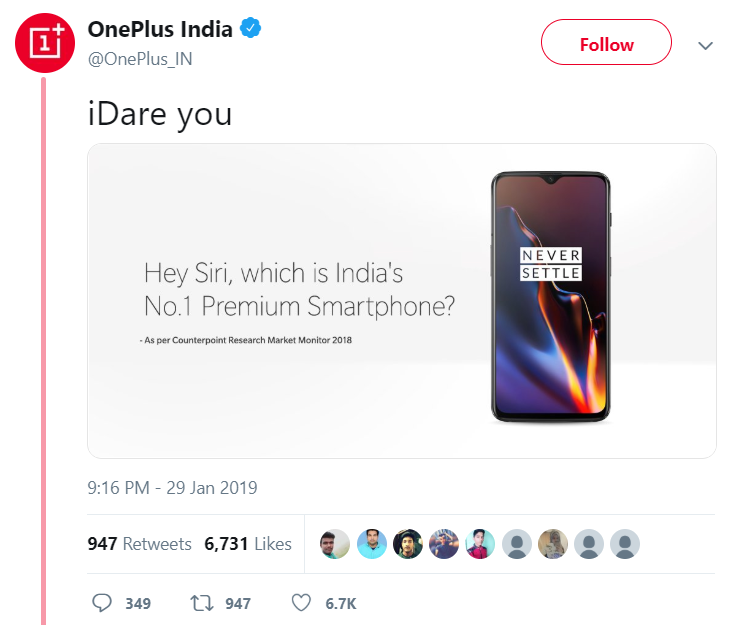
OnePlus also broke another of their rules, carrying out heavy marketing campaigns including sponsoring cricket games and celebrity endorsements (evidence of this can be found on OnePlus’s Indian Youtube channel) across the nation which certainly paid off. It’s difficult finding accurate figures but various reports show that OnePlus are leading the way in the Indian premium smartphone market, some even suggesting OnePlus own 50% share, something that Apple have struggled to achieve. In true OnePlus style, they couldn’t help but tease Apple with the following tweet.
Final thoughts
With the OnePlus 7 expected to release mid 2019 the company continues to cement itself as one of the top smartphone manufacturers in the world, in a sense becoming a giant themselves. Technology is difficult to predict and past success does not guarantee growth. Although OnePlus appears to be growing sustainably there is the danger they’ve reached the peak of their hype cycle, they should not become complacent or face the danger of a new start up turning the tables on them!
References
[1] Gill, P. May 2018. “OnePlus owns 50% of India’s premium smartphone market share” Available at: https://www.techradar.com/uk/news/oneplus-owns-50-of-indias-premium-smartphone-market-share Accessed: 27th February 2019
[2] Williams, A. May 2018. “OnePlus history: from viral marketing maverick to flagship killer” Available at: https://www.techradar.com/uk/news/oneplus-history-from-viral-marketing-maverick-to-flagship-killer Accessed 25th February 2019
[3] Lebreton, Maël et al. 2012. “Your goal is mine: unraveling mimetic desires in the human brain.” The Journal of neuroscience : the official journal of the Society for Neuroscience32 21 (2012): 7146-57 .
[4] Teece, D.J. & Linden, G. J Org Design (2017) 6: 8. https://doi.org/10.1186/s41469-017-0018-x
[5] Reuters. 2018. “OnePlus is giving Apple a tough time in India and problems go beyond price!” Avaliable at: https://www.financialexpress.com/industry/can-apple-overcome-oneplus-challenge-in-india/1375516/ Accessed 27th February 2019
 Tom's Data Science Journey